Showing posts with label QQ. Show all posts

Wednesday, July 12, 2017

Next Steps for a Connected Educator

Though I’ve been connected on social media for a few years, I feel like there should be more to the network, the community, the redefinition of it…all of this has made me think about the next steps I could should take when utilizing it as well as technology and the place they have within the innovation I myself as a person and teacher should strive for.

To be honest, when it comes to social media, I’ve already started to utilize Feedly, Pinterest, Evernote, and Twitter into my own personal methods of professional development and collaboration (though Evernote is on its last leg). Feedly came within the last couple months off of a recommendation from Steven Anderson since I couldn’t find a quality app for Blogger on the App Store. I initially didn’t join Pinterest because I used to think it was only for recipes, decoration ideas, and wedding planning. Little did I know with such a naïve mind. It’s great for curating content while Evernote allows me to save the article then and there in various ways. (Side notes: Pinterest is now blocked in China as of a few weeks ago, Evernote is in Chinese on the local internet, and Twitter has been game-changing. Who would have thought any of those would have happened?)

What I have found is that simply joining these platforms is not enough in itself. Lurking is a decent first step, but to move forward one must learn how to partake, collaborate, and create when ready. Therefore, I joined ISTE’s #ETCoaches / Blogging Buddies a month or so back to obtain more interaction and communal growth. I would also like to start utilizing YouTube and possibly YouKu (China’s YouTube) more often along with the inclusion of more multimedia than just simply pictures within posts/sharing. Then there's live-streaming, whether it be Periscope or YouTube.

Some of these tools have Chinese versions (in-app or on the website), which I always check when browsing the App Store or web. It’s also been vital to check the Chinese App Store since there are some apps present or missing when compared to the American one.

http://www.flickr.com/photos/25275534@N00/8631695619
I’ve been using American platforms, but I’d like to take a step with Chinese ones as well. I’m still considering how to do this long-term, and that includes how to get the most out of WeChat, QQ, and Weibo (China’s Twitter). WeChat is the big one here, and it very well may have an effect on your internet. With that said, I don’t want to keep switching between what kind of internet or which social media I use because the students and colleagues I interact with on a daily basis usually surf a different one from the one I’ve been accustomed to. (If only there was a Chinese version of Buffer.)

How should I go about this? Which steps would you suggest or take in this situation?

What steps can you take to go outside your comfort zone and move forward in your journey as a connected educator?

Photo Credits: ePublicist

Friday, June 30, 2017

When Should a Student (be Allowed to) Get Facebook?

Two different questions have been on my mind recently.

Firstly…

When should a student get Facebook?

I recall asking my sixth-grade nephew once if he had Facebook. “I don’t need it,” he responded.

That threw me off.

Students at my former school obtained a smartphone and/or an iPad by mid-elementary, and there’s certainly a different age requirement than 13 in China. I say this because a lot of elementary students already have WeChat or QQ (social media platforms with chats, posts, and so much more). I didn’t even stop to consider how one of my 6th graders recently asked to add me on Facebook. Reflecting on all of that had led me to wrongfully assume that every child I met as young as mid-elementary would desire to connect via social media. Low and behold, every child’s life and context are different. When a child actually wants to get Facebook more than likely varies on lots of factors, many of which we as outsiders to their lives may not know about. (For more on ways we may misunderstand teens and technology, please check out danah boyd’s It’s Complicated.)

I didn’t think of the fact that my nephew was under 13 years old when I asked him either. Thankfully I haven’t met, heard of, or needed to report anyone under 13 using Facebook. This brought me to the following question…

https://goo.gl/images/gdUWnB
When should a student be allowed to get Facebook?

Little did I know about the Children’s Online Privacy Protection Act (COPPA), a law passed in 1998 to protect children under 13 from having their personal information available. Thus, Facebook’s age requirement is 13. Most other apps/sites have the same condition while some range lower or higher.

Common Sense Media has much to say about protection and guidelines for social media, along with what is going on at age 13 developmentally. Parents and teachers alike should take heed and stay informed. This will help when striving to understand what pre-teens are going through. It should be strongly suggested for the parent as well to be involved in the child’s life during this time since children lying about how old they are may put peers at risk. (Side note: This would be a great time for adults to also examine our social media habits and behaviors because, as I have discovered in parenting and teaching, I and other adults still have some maturing to do too. Children are NOT alone in this manner.)

All of that makes sense while there are certainly “teachable moments” to be learned earlier in life, including those for a six year-old on Snapchat. But…can not the parent help guide the child in using social media such as Facebook before reaching the age of 13? Can the parent learn from the child? I’m not prompting you to push social media on to your child and lie about his/her age. (There are other ways to justify looking at your phone more than your child.) Don’t misinterpret that. What I’m urging is that we as adults be ready to understand the child, listen to his desires, and most importantly, steer him in the moral way to live before he is 13. The life the child lives offline will undoubtedly determine who he is online.

Wednesday, April 19, 2017

“Mr. Scott, do you have Facebook?”

A student asked me this question as soon as class was done today, and it threw me for a loop. Not because I was surprised at his question, but because it had taken most of the school year to go by before any student inquired about American social media. This same student, last semester, started to share about VPNs with me. Sooner rather than later, he acquired one (for quite a cheap price, I might add). Last year, I had several 6th graders who had VPNs and used them mainly, it seemed, to browse Instagram.

He then sought to know if I would connect with him if he were to add me as a friend. I explained the boundaries I consider vital between current students and teacher on American social media, how it could influence both sides, and how some distance is needed. What’s ironic is that I’m connected to almost every one of my students on Chinese social media such as WeChat or QQ. Chinese and American cultures and their rules vary while I’m still contemplating this aspect as well as how I can integrate the two. 


This question then led my thoughts to split off with curiosity.

1) How free is the internet that my students access and use? How will it affect their lives and education in a Chinese society?

2) How long will Chinese internet, controlled by the Great Firewall, last against students? As a Chinese colleague told me recently, college students are some of the biggest threats to national security.

3) Do I connect with this student on Facebook? Or am I truly setting myself up if I do this? Mind you, the student showed me how he connects to his VPN and then can check Twitter. (Maybe I should show him the power of Twitter as a teacher with my PLN?)

What do you think? 


(As for questions under 1 and 2, more of those thoughts shall be addressed when sharing my reflections on Zhao Yong’s book, Who’s Afraid of the Big Bad Dragon?)

Saturday, November 29, 2014

A Spark Chat on QQ

My officemates could be the first to tell you that I'm big on integrating tech tools into my teaching as well as for our PLC at school in order for everyone to experience connected learning. These two men know that my longterm goal is to get them on Twitter, and it's only a matter of weeks or days. But in the meantime, I've been playing with various social media platforms on the China-side of the Firewall even if all of our foreign teachers (Ts not from China) have VPNs. Slowly we'll all learn how to use foreign internet for professional reasons too. :D

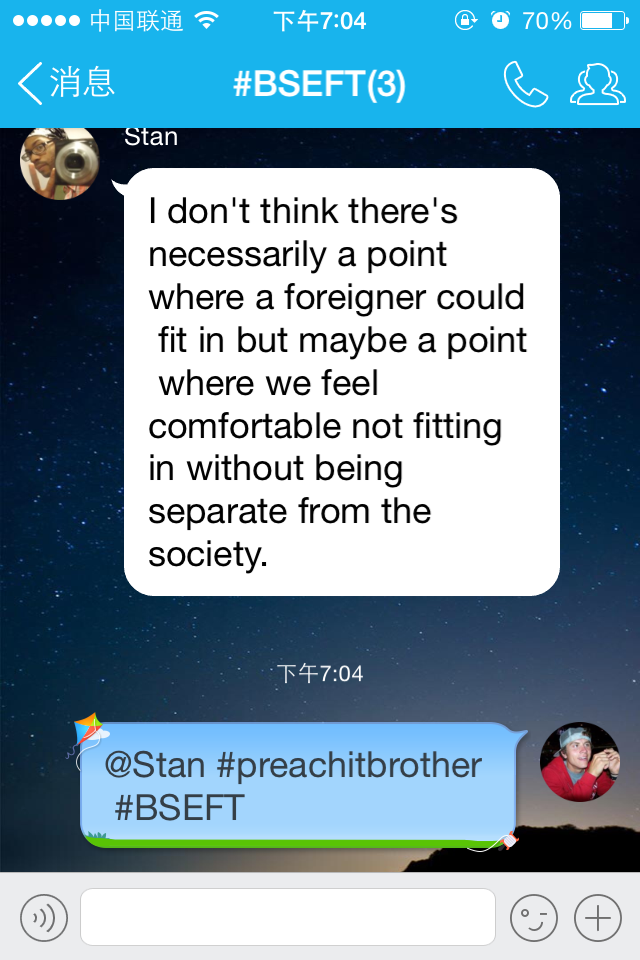
For an introduction to Twitter chats, I first suggested that we use an app called QQ. The guys agreed so we set up last night (Thursday) to have a spark chat from 6:30-6:45pm. Now, QQ is more of a chat/public posting app or website. The group chat feature is tolerable since there's no mentioning nor favoriting capabilities. You can mention others in WeChat, but it is also mostly convenient for devices. While one of the guys doesn't have a working smartphone, we went with QQ.

our group chat where we practiced mentions & hashtags
I'll be honest, and say that I was ecstatic about the spark chat. Earlier in the day, one of them suggested that we do a more personal topic because of all the professional interactions we have. (The other T and I agree though we both hinted at how we don't really have enough of that kind of talk.) I decided not to be too forceful with keeping it professional because a chat alone was a step. So we agreed to discuss: What is one thing you would share/do for a person new to China? This topic came to mind from a dialogue I had with Scott Capro, co-founder of #BFC530. This particular spark chat is amazing, and not every morning does it simply entail methods, management tips, or how to implement new ideas. It can hit on the heart and soul of an assortment of education issues.

So just like that, our #BSEFT (BaiShan Elementary Foreign Teacher) chat took off! Comments and questions started clicking almost as soon as we started. And before I knew it, one of them delivered our #micdrop to end it.


I decided in the midst of the chat a couple times to post screenshots of Stan's (one of my colleagues) comments on Twitter. I wanted to see what kind of response I would receive from a more global audience. It didn't take very long for the teamwork quote to get favorited and retweeted. When I passed this information on to him today, he was happy to help and then went on about his father's quotes. I simply re-emphasized how he made a global impact with just one line and one click whether or not it is a quote from our fathers or not (haha).

That's the power of social media. A spark chat on QQ with my PLC in China or a conversation with my PLN on Voxer from China to NJ and CO in the States. It's happening...worldwide collaboration. Anywhere, anytime, with anybody you choose. Thus, why I'm now reading Steven Anderson and Tom Whitby's The Relevant Educator. I would like the teachers at my school to experience the power that is on tap in the palm of one's hand.